Nigeria's AML Rules Just Changed. Is Your Financial Institution Ready for What Comes Next?
By Anita Ojieh
on August 14, 2026

Nigeria's AML Rules Just Changed. Is Your Financial Institution Ready for What Comes Next?
Nigeria's financial sector is entering a new era of financial crime prevention.
On March 10, 2026, the Central Bank of Nigeria (CBN) issued its Baseline Standards for Automated Anti-Money Laundering (AML), Countering the Financing of Terrorism (CFT), and Countering Proliferation Financing (CPF) Solutions, under Circular BSD/DIR/PUB/LAB/019/002.
The message is clear: as financial services become more digital, financial institutions can no longer depend on largely manual processes to identify and respond to financial crime.
Banks, fintechs, payment service providers, mobile money operators, international money transfer operators, and other CBN-regulated institutions are now required to run automated systems that can monitor activity, identify suspicious behaviour, support investigations, and enable timely reporting.
For financial institutions, this is more than another compliance requirement. It is a technology transformation opportunity.
Why This Matters Now
Nigeria's financial ecosystem has changed dramatically. Customers can open accounts digitally, move money instantly, make payments across multiple channels, and interact with financial institutions without ever entering a branch.
But the same digital infrastructure that makes financial services faster and more accessible also creates more opportunities for fraud, money laundering, and other forms of financial crime.
Traditional rule-based and manual processes struggle when transaction volumes are high and suspicious behaviour is spread across multiple accounts, channels, and transactions.
The CBN's new standards recognise this reality by setting baseline requirements for automated AML solutions and encouraging the use of technologies such as artificial intelligence, machine learning, anomaly detection, behavioural analysis, and automated risk scoring, spanning 12 standards and roughly 100 individual requirements in total.
What the New CBN Standards Mean for Banks and Fintechs
Financial institutions are expected to move toward integrated systems capable of supporting:
- Automated customer due diligence and risk profiling
- Sanctions and PEP screening
- Transaction monitoring
- Suspicious activity detection
- Case management and investigation
- Regulatory reporting
- Fraud monitoring
- Risk-based analysis across customer and transaction data
The standards also emphasise that automated systems should work with the institution's wider technology environment, creating a more complete picture of customer and transaction risk. Notably, AML systems that are not effectively linked to CDD, KYC, and KYB data will not be regarded as compliant, even if the monitoring engine itself works well.
This changes the question for financial institutions. It is no longer simply:
"Do we have an AML system?"
The better question is:
"Can our systems identify suspicious behaviour quickly, explain why it was flagged, and help our teams intervene before financial crime causes greater damage?"
AI Has a Role, But Humans Still Matter
The CBN's recognition of AI and machine learning is particularly significant.
AI can help financial institutions identify patterns that are difficult to detect through traditional rules alone, including unusual transaction behaviour, anomalies, changes in customer behaviour, and relationships between seemingly unrelated accounts.
But AI should not operate as a black box. For regulated financial institutions, the ability to understand why a transaction or customer was flagged is just as important as identifying the risk in the first place.
This is why the CBN's framework places real emphasis on governance, model validation, explainability, and human oversight. The future is not about replacing compliance and fraud teams with AI. It is about giving those teams better intelligence, earlier warnings, and the ability to act faster.
AML and Fraud Can No Longer Operate in Silos
One of the most important implications of the new direction is the convergence of AML and fraud monitoring.
A suspicious transaction may be more than a fraud event. It could be part of a larger pattern involving multiple accounts, money movement, identity abuse, or attempts to disguise the source of funds. Similarly, a fraud network can sometimes reveal relationships that traditional AML monitoring would not otherwise surface.
This is why financial institutions increasingly need a connected view across:
Identity → Transactions → Behaviour → Risk → Fraud → Investigation → Action
The CBN's standards point toward this more integrated approach, including monitoring across cards, electronic channels, deposits, and lending platforms.
Where AI Can Make a Practical Difference
AI-powered financial systems can support institutions across several critical areas.
1. Real-Time Fraud Detection
Identify unusual transaction patterns and suspicious behaviour across digital payment channels, allowing institutions to intervene before fraudulent activity is completed.
2. AML Transaction Monitoring
Analyse transactions against customer profiles and historical behaviour to identify potentially suspicious activity that may require investigation.
3. Customer Risk Profiling
Continuously assess customer behaviour and risk indicators rather than relying only on information collected during onboarding.
4. Investigation Support
Help investigators review alerts, connect relevant information, and prioritise cases that require immediate human attention.
5. Automated Compliance Workflows
Reduce the manual effort involved in reviewing alerts, preparing reports, documenting investigations, and escalating cases.
6. Explainable Risk Intelligence
Give compliance and fraud teams visibility into the factors behind an alert so they can make informed decisions rather than simply accepting an automated recommendation.
Where CloudPlexo Comes In
At CloudPlexo, we believe the future of financial services will be built around intelligent, connected, and secure technology. Our work with financial institutions is increasingly centred on helping them use AI and cloud technologies, backed by our AWS partnership, to solve practical business and operational challenges.
Two solutions are particularly relevant to this emerging financial crime landscape.
AgentSpec
AgentSpec provides AI agents that support financial operations and workflows. For banks, fintechs, and finance teams, this can include reconciliation, customer support, financial operations, credit assessment, loan underwriting, and other processes where intelligent automation reduces manual work and accelerates decision-making.
The opportunity is to move beyond AI as a chatbot and embed intelligent agents directly into financial workflows.

Threadline
Threadline focuses specifically on fraud detection and escalation. It is designed to help organisations identify suspicious activity, detect potential fraud, and escalate cases for appropriate intervention.
This creates an important layer between detection and action, because identifying a suspicious transaction is only the first step. The real value comes from being able to detect, understand, escalate, and respond.
Both solutions sit on top of the security and compliance and data analytics foundations we build for financial institutions on AWS, backed by cybersecurity practices designed for regulated environments.
The Opportunity for Financial Institutions
The CBN's new standards create a clear direction for the Nigerian financial sector. But compliance should not be approached simply as a regulatory box to tick.
The right technology can simultaneously help financial institutions:
- Reduce financial crime risk
- Improve compliance operations
- Reduce manual investigation work
- Respond to fraud faster
- Improve customer protection
- Create better visibility across financial activity
- Build stronger and more resilient financial systems
For institutions that have not yet started, the time to assess current infrastructure is now. Under the standards, institutions must submit implementation roadmaps to the CBN's Compliance Department within three months of issuance, by 10 June 2026, with Deposit Money Banks given 18 months and other financial institutions up to 24 months from the date of issuance to reach full compliance. The CBN has also been explicit that institutions failing to implement effective controls, or personnel responsible for that implementation, may face sanctions under existing AML/CFT/CPF regulations.
Frequently Asked Questions
When do CBN's new AML standards take effect? The Baseline Standards took effect on the date of issuance, 10 March 2026. Implementation roadmaps are due to the CBN's Compliance Department by 10 June 2026, three months after issuance.
Who has to comply with the CBN Baseline Standards? All CBN-regulated institutions, including deposit money banks, fintechs, payment service providers, mobile money operators, microfinance banks, and international money transfer operators. All institutions must meet all 12 standards, though the CBN applies a proportionality principle to how sophisticated each institution's implementation needs to be based on size, risk profile, and transaction complexity.
What is the compliance deadline for full implementation? Deposit Money Banks have 18 months from the date of issuance (by roughly September 2027), while other financial institutions have 24 months (by roughly March 2028).
What happens if an institution doesn't comply? Institutions that fail to implement the standards, or whose AML/CFT/CPF controls remain ineffective, may face penalties under the CBN AML-CFT-CPF Administrative Sanctions Regulations 2023 and the Banks and Other Financial Institutions Act. Liability can extend to the personnel responsible for implementation, not only the institution.
From Compliance Requirement to Competitive Advantage
Nigeria's financial sector is becoming increasingly digital. The next generation of financial institutions will not only process transactions faster. They will be better equipped to understand risk, identify threats, and respond to them in real time.
The CBN has provided the regulatory direction. Now financial institutions need the technology, infrastructure, and expertise to execute.
CloudPlexo helps financial institutions navigate that transition. From AI-powered financial operations with AgentSpec to intelligent fraud detection and escalation with Threadline, we are building technology for a financial sector where security, compliance, and intelligent automation increasingly work together.
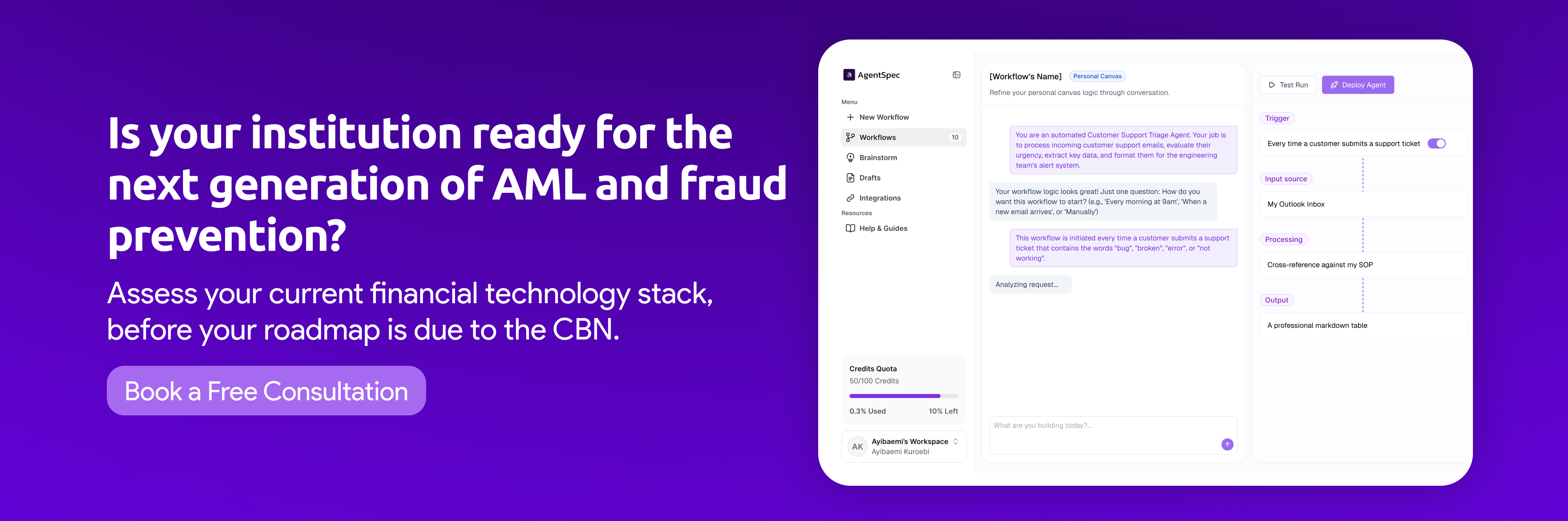
Is your institution ready for the next generation of AML and fraud prevention?
Talk to CloudPlexo about assessing your current financial crime technology stack and identifying opportunities for automation, AI, and intelligent risk monitoring, before your implementation roadmap is due.